

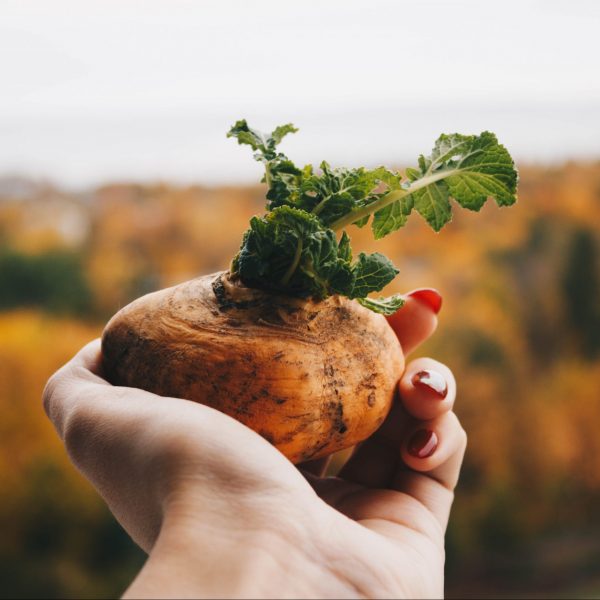
Maca (Lepidium meyenii) is a root-like cruciferous vegetable from the Andes of Peru. It grows in some of the harshest farmlands in the world; experiencing freezing temperatures, fierce winds and intense sunlight. Often the soil is rich in volcanic minerals. Maca is the only food crop in the world that can grow and thrive at such a high altitude and in such harsh weather. For more than two millennia, native Peruvians have used Maca root as food and medicine to promote fertility, endurance, energy, vitality, and sexual virility.
Stories of Maca’s fertility-supporting effects have been passed down through history in a story that took place in the 1500s. Soon after the Spanish Conquest in South America occurred the Spanish began to experience poor health and infertility, and so did their livestock. This was due to the high altitude of the Andes. The native Peruvians recommended that they feed their livestock and themselves Maca. The results were so dramatic that many of the first written records ever kept for the Andean region were passages about Maca. There are also historical notes recording that the Conquistadors began demanding to be paid in Maca instead of gold.
How Maca Works
Containing 31 different minerals and 60 different phytonutrients, Maca is a nourishing food for the endocrine system, aiding the pituitary, adrenal, and thyroid glands (all involved in hormonal balance.) Maca has the ability to affect key hormones in both women and men without containing hormones itself.
Maca has been scientifically researched for increasing fertility since 1961 and has been shown to contain specific compounds called glucosinolates which can affect fertility for both men and women. These alkaloids are responsible for Maca’s ability to support hormonal balance.
Benefits of maca:
- Supports hormonal balance
- Increases energy, stamina, and mental clarity
- Supports the thyroid
- Supports normal sexual function
Adaptogenic
Maca also has adaptogenic properties, which means it helps to strengthen the body so it is able to better resist disease and stress, supports the adrenal glands, and balances the body’s functions. In order for an herb to be considered an adaptogen, it must be non-toxic or harmless to any organ of the body and must be able to be ingested for long periods of time safely. Maca is classified as an adaptogen.
In a 2014 clinical study of mice in the Journal of Clinical Food, Maca extract (doses: 250 and 500 mg/kg) was found to reduce corticosterone (and adrenal corticosteroids) levels, increase noradrenaline and dopamine levels, and inhibit reactive oxygen species (ROS) activity (oxidative stress) proving it’s antidepressant-like effects.
Endocrine System Tonic
One of Maca’s main actions is to stimulate and nourish the hypothalamus which regulates the pituitary gland, acting as a tonic for the hormone system. When the pituitary gland functions optimally, the entire endocrine system becomes balanced, because the pituitary gland controls the hormone output of the adrenals, thyroid and sex organs (testes in men and ovaries in women).
Promotes Hormonal Balance
In women, maca helps the body to promote balanced estrogen and progesterone levels. Estrogen or progesterone levels that are high or low at the wrong time can keep a woman from becoming pregnant or keep her from carrying to term. Excess estrogen levels can cause progesterone levels to become too low; this is known as estrogen dominance. Taking maca may help to balance the estrogen to progesterone ratio, which is essential to achieving and carrying a healthy pregnancy.
Too much estrogen in men may cause erectile dysfunction, lack of libido, low sperm count, and lowered production of seminal fluid. Studies shared of in Healthnotes by the University of Michigan have shown that men who use maca may experience an increased libido and an increase in sperm health.
In one study, maca was given to female and male rats and it was found that the females had multiple egg follicle maturation (important for ovulation); the males had significantly higher sperm production and motility rates.
Supports Normal Sexual Function
A small, clinical, human study in 2001 in the Asian J Andro, nine men who were given gelatinized maca for 4 months at 1,500 – 3,000 mg a day and experienced an increase in libido, sperm count, motility of sperm, DHEA levels, as well as decreased anxiety and stress, lowered blood pressure, balanced iron levels, and an increase in adrenal androgens.
Click here to shop Fertilica™TM Maca Root.
How to Use Maca
When purchasing maca, you want to make sure the product you are using has only maca root in it, not leaves or stems. Maca is available in powder, capsules or tincture. It is also available in varying strengths.
Maca powder: Maca powder comes in two forms. Plain maca powder that is just raw powdered maca root, or gelatinized maca. Gelatinization is a completely vegetarian process that removes the starch from maca to improve assimilation and make it more concentrated.
We find that gelatinized maca is easier to digest than the plain powder and is also more cost-effective since it is more concentrated. The studies mentioned above used gelatinized maca. Gelatinization does not refer to “gelatin”, and no animal-derived ingredients are incorporated into this process.
Maca powder can be added to juice, smoothies, yogurt or baked goods. It has a nice malty flavor which goes well with foods. I like to add it to all of my smoothies.
Maca capsules: Maca capsules are a convenient way to get Maca daily. Many people will find using the Maca capsules to be easier since they can be taken at any time with some water.
Maca tincture: A tincture of maca root is a liquid extract of the medicinal properties of maca. Maca tincture can be taken with water, in juice or added to smoothies.
Dosage
General suggested usage is 500-3000 mg a day. To obtain desired results, maca needs to be taken regularly. It can be taken in one dose or throughout the day.
Note: Maca is slightly energy stimulating and because of this we find that it is best taken prior to 3pm, so that nighttime sleep is not disturbed in any way.
Safety & Side Effects
Maca is a beneficial herb that has been used for thousands of years and consumed everyday as a food and medicine by the Peruvians. Based on its long history of use as a food, it appears to be very safe. Toxicity studies (conducted at Product Safety Labs of East Brunswick, N.J.) showed absolutely no toxicity and no adverse pharmacological effects.
A small number of women experienced stomach upset when consuming plain maca root (not gelatinized). Additionally, some women experience spotting or a change in their menstrual cycle when they first begin using maca. This is normal and a sign that the body is beginning to balance the hormonal system.
Maca Use During Pregnancy
As a safety precaution most manufacturers state that their supplements should not be used during pregnancy. There have been no studies on the use of maca during pregnancy. Acute toxicity studies and cytotoxicity evaluations have demonstrated an absence of any evidence of potential toxicity of maca. The Peruvians have been consuming maca as a food for thousands of years. Since there have been no studies on the use of maca during pregnancy we can not state that it is proven safe to use during pregnancy. Please do your own research and make a personal decision on the use of maca during your pregnancy.
Summary
As you can see from all the actions maca can have on the body, it is a wonderful fertility superfood and tonic. Maca can complement any fertility program and should be used on a daily basis for the best results. It can also be used in conjunction with other fertility herbs and supplements.
Click here to shop for FertilicaTM Maca Root
Learn more about using Maca for fertility through our useful Q&A…
- Ai, Z., Cheng, A. F., Yu, Y. T., Yu, L. J., & Jin, W. (2014). Antidepressant-like behavioral, anatomical, and biochemical effects of petroleum ether extract from maca (Lepidium meyenii) in mice exposed to chronic unpredictable mild stress. Journal of medicinal food, 17(5), 535-42. Retrieved from https://www.ncbi.nlm.nih.gov/pmc/articles/PMC4025608/
- Meissner, H. O., Kapczynski, W., Mscisz, A., & Lutomski, J. (2005). Use of gelatinized maca (lepidium peruvianum) in early postmenopausal women. International journal of biomedical science: IJBS, 1(1), 33. Retrieved online from: http://www.ncbi.nlm.nih.gov/pmc/articles/PMC3614576/
- Maca (Last Review: 06-01-2015) Healthnotes. University of Michigan. Retrieved from https://www.uofmhealth.org/health-library/hn-4392007#hn-4392007-uses
- Gonzales, G. F., Cordova, A., Gonzales, C., Chung, A., Vega, K., & Villena, A. (2001). Lepidium meyenii (Maca) improved semen parameters in adult men. Asian Journal of Andrology, 3(4), 301-303. Retrieved from: http://www.asiaandro.com/archive/1008-682X/3/301.htm
- Ostrowski Meissner, H., Kapczyński, W., Mścisz, A., & Lutomski, J. (2003). An attempt to use a Maca (Lepidium peruvianum) in women in the early postmenopausal period. Postępy Fitoterapii. Retrieved from: http://www.czytelniamedyczna.pl/2515,proba-zastosowania-maca-lepidium-peruvianum-u-kobiet-w-okresie-wczesnej-postmeno.html
- Muller V. Maca in Hormone Replacement Therapy. Whole World Botanicals Report; 17
- Muller V. (2002). South American Herb Maca as Alternative to Hormone Replacement Therapy. Whole World Botanicals Report. Retrieved from: http://kokming.com/smsmaca/MacaasAlternativetoHormoneReplacementTherapy.htm
- Walker M. (1998). Effect of Peruvian Maca on Hormonal Functions. Townsend Letter for Doctors and Patients; 11: 18.
- Cicero, A. F., Piacente, S., Plaza, A., Sala, E., Arletti, R., & Pizza, C. (2002). Hexanic Maca extract improves rat sexual performance more effectively than methanolic and chloroformic Maca extracts. Andrologia, 34(3), 177-179. doi:10.1046/j.1439-0272.2002.00490.x Retrieved from: https://onlinelibrary.wiley.com/doi/full/10.1046/j.1439-0272.2002.00490.x
- Gonzales, G. F., Ruiz, A., Gonzales, C., Villegas, L., & Cordova, A. (2001). Effect of Lepidium meyenii (maca) roots on spermatogenesis of male rats. Asian J Androl, 3(3), 2313. Retrieved from: http://www.asiaandro.com/archive/1008-682X/3/231.htm
- Cicero, A. F., Bandieri, E., & Arletti, R. (2001). Lepidium meyenii Walp. improves sexual behaviour in male rats independently from its action on spontaneous locomotor activity. Journal of Ethnopharmacology, 75(2). 225229. Retrieved from: https://www.sciencedirect.com/science/article/pii/S0378874101001957
- Li, G., Ammermann, U., & Quirós, C. F. (2001). Glucosinolate contents in maca (Lepidium peruvianum Chacon) seeds, sprouts, mature plants and several derived commercial products. Economic botany, 55(2), 255262. Retrieved from: https://link.springer.com/article/10.1007/BF02864563
- Dini, A., Migliuolo, G., Rastrelli, L., Saturnino, P., & Schettino, O. (1994). Chemical composition of Lepidium meyenii. Food chemistry, 49(4), 347349. Retrieved from: https://www.sciencedirect.com/science/article/pii/0308814694900035
- Fahey, J. W., Zalcmann, A. T., & Talalay, P. (2001). The chemical diversity and distribution of
glucosinolates and isothiocyanates among plants. Phytochemistry, 56(1), 551.Retrieved from: https://www.sciencedirect.com/science/article/abs/pii/S0031942200003162
- Ganzera, M., Zhao, J., Muhammad, I., & Khan, I. A. (2002). Chemical profiling and standardization of Lepidium meyenii (Maca) by reversed phase high performance liquid chromatography. Chemical and pharmaceutical bulletin, 50(7), 988991. Retrieved from: https://www.jstage.jst.go.jp/article/cpb/50/7/50_7_988/_article
- Sandovala, M., Okuhamaa, N. N., Angelesa, F. M., Melchora, V. V., Condezob, L. A., Laob, J., & Millera, M. J. (2002). Antioxidant activity of the cruciferous vegetable Maca (Lepidium meyenii). Food Chemistry, 79(207), 17. Retrieved from: https://www.sciencedirect.com/science/article/pii/S0308814602001334
- Clément, C., Diaz G., Diego A., Bharathi A., Khan I. A. , et al. (2010). Influence of colour type and previous cultivation on secondary metabolites in hypocotyls and leaves of maca (Lepidium meyenii Walpers). Journal of the Science of Food and Agriculture. 90 (5): 861–869. Retrieved from: https://onlinelibrary.wiley.com/doi/abs/10.1002/jsfa.3896