

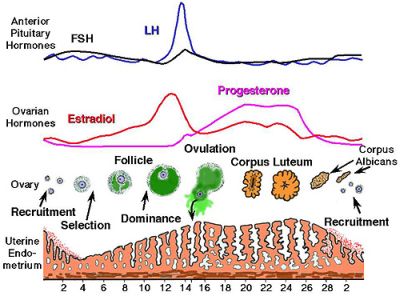
Hormonal Balance is an important factor when it comes to healthy fertility and getting pregnant. Throughout the menstrual cycle various hormones are working together in a complex symphony to trigger the components of ovulation and menstruation.
Progesterone is one of these key hormones. After ovulation progesterone production is triggered by Luteinizing Hormone (LH) which stimulates the corpus luteum (the remnant egg sac) in the ovary to produce progesterone. One of the main actions of progesterone with fertility is to help support a developing embryo.
If pregnancy occurs, the production of progesterone from the corpus luteum continues for about 7 weeks (it is then produced by the placenta for the duration of the pregnancy). If pregnancy did not occur, the period begins approximately 14 days after ovulation. When fertilization does not occur the corpus luteum disintegrates, which causes the level of progesterone to fall and the endometrial tissue starts to break-down and shed as menstruation.
What Does Progesterone Do?
- Progesterone maintains the lining of the uterus which makes it possible for a fertilized egg to attach and survive
- Allows the embryo to survive
- Prevents immune rejection of the developing baby
- Allows for full development of the fetus through pregnancy
- Helps the body use fat for energy during pregnancy
- Prevents secondary sexual development
- Increases libido around ovulation
- Activates osteoblasts to increase new bone formation
- Protects against endometrial, breast, ovarian and prostate cancer
Are You Progesterone Deficient or Estrogen Dominate?
Too much estrogen in the body
One of the main reasons women are progesterone deficient is because they have too much estrogen in the body.Estrogen dominance can happen for many reasons:
- Commercially raised meats and dairy contain large amounts of estrogens, and consuming them can cause hormonal imbalance.
- Pollution and stress mimic estrogen at the estrogen receptor sites.
- Eating a large amount of processed soy products can also mimic estrogen.
- PCOS and endometriosis can produce excess estrogen.
Symptoms of estrogen dominance
- Allergy symptoms like asthma and hives
- Breast cancer
- Breast tenderness
- Decreased sex drive
- Depression with agitation and/or anxiety
- Dry eyes
- Early onset of menstruation
- Fat gain, usually around the middles
- Fatigue
- Sluggish metabolism
- Foggy thinking
- Hair loss
- Headaches
- Increased blood clotting
- Fertility issues
- Irregular periods
- Insomnia
- PMS
- Polycystic ovaries
Not enough progesterone in the body
There are many signs that may show up in the body if you do not have enough progesterone in your system during the correct times of your cycle.
Symptoms of Progesterone Deficiency
- Recurrent early miscarriage
- No period
- Not ovulating
- Endometriosis
- PCOS
- PMS
- Cramps during menses
- Excess bleeding during menses
- Swollen breasts
- Fibrocystic breasts
- Loss of libido
- Obesity
- Depression
- Water retention
- Low thyroid
- Facial hair
- Hot flashes
- Night sweats
- Vaginal dryness
- Foggy thinking
- Memory lapse
- Incontinence
- Tearful
- Depressed
- Sleep disturbances
- Heart palpitations
- Bone loss
Click here to learn about Fertilica™ Natural Progesterone
Hormone Testing
Hormone testing can be performed by a medical doctor, naturopathic doctor or by an at-home testing service. Testing options range from charting your menstrual cycle to determine the length of your luteal phase, to basal body temperature tracking during your luteal (consistently low BBT may indicate low progesterone production), to taking saliva or blood tests to find out your progesterone levels. The questionnaire above helps to point out signs of progesterone deficiency while these tests help to confirm it.
BBT Charting
Basil Body Temperature charting can help to determine the availability of progesterone in the luteal phase. There will be a slight, steady rise in temperature after ovulation has occurred and progesterone has increased. An irregular or consistently low BBT may indicate low progesterone and luteal phase defect.
Length of luteal phase
If the date of ovulation is fewer than 11 days before your period, this could suggest luteal phase defects. You can detect ovulation using BBT charting or by using ovulation detector strip tests.
Saliva Hormonal Testing
Dr. John Lee was very adamant that testing for hormones and progesterone should be done through saliva testing, not blood testing (almost all doctors will test the blood).
You can order an “at home” saliva test that you will take at certain times during your cycle and then send away to a lab for analysis. They will then mail back the results so you can find out if you have any hormonal imbalances.
Blood Hormonal Testing
While Dr. Lee was adamant about getting progesterone testing through saliva, it may be more helpful to work with your doctor to get your progesterone tested so they can explain the test results to you, even if it is a blood test. You most likely will also have other hormones tested at the same time which can give you insights to your entire hormonal profile.
When to Get Your Progesterone Levels Tested
The most appropriate time to measure serum progesterone is mid luteal phase (either 7 days after ovulation, or 7 days prior to expected menses). This is when you’re most likely to catch the peak progesterone level. This day will vary according to a woman’s cycle length (for example, for a 28 day cycle, day 21 progesterone testing is appropriate; but for a 35 day cycle, progesterone would ideally be measured around day 28).
How to Support Progesterone Levels
1. Reduce your exposure to xenohormones
We have become an estrogen dominate society from all of the excess estrogen in our foods and environment.
Reduce your exposure by avoiding these xenohormone producers:
- Solvents and adhesives
- Meat from conventionally raised livestock (non-organic)
- Car exhaust
- Almost all plastics
- Petrochemically derived pesticides, herbicides, and fungicides
- Emulsifiers found in soaps and cosmetics
- PCD’s from industrial waste
2. Vitex for hormonal balance
Vitex (Chaste Tree Berry) is one of the most powerful herbs for women’s fertility and menstrual health. There are numerous studies and testimonials of Vitex and its effects on the body. One of the reasons Vitex is so effective and popular is because of its ability to balance hormones while not containing hormones itself. Vitex supports hormonal balance in the body by having an effect on the hypothalamic-pituitary-ovarian axis (hormonal feedback loop), correcting the problem at the source.
Yale trained MD, Midwife and Herbalist Aviva Romm shares in her podcast 5 Ways Vitex Can Help Your Hormones that “In one trial, 48 women (ages 23 to 39) who were diagnosed with infertility took vitex once daily for three months. Seven women became pregnant during the trial, and 25 women experienced normalized progesterone levels – which may increase future chances of pregnancy.”
Directions for use
Capsules: 1,000mg a day is the suggested amount to use. Take vitex all month long.
Tincture: 90 drops in water or juice, first thing in the morning. All month long.
Unlike powerful hormone drugs, vitex works slowly to normalize the body. Maximum benefits are often achieved after 6-12 cycles with vitex.
3. Use Natural Progesterone Cream
Natural progesterone cream can help to supplement your body’s own progesterone levels and lead you back to a state of natural balance.
Natural progesterone cream comes from plant fats and oils called diosgenin which is extracted either from Mexican Wild Yams or soybeans. In the laboratory diosgenin is chemically synthesized into a molecular structure that is identical to real human progesterone.
The United States Pharmacopoeia (USP) denotes a recognized standard of purity and strength. It is sometimes referred to as “human-identical” or “bio-identical” progesterone, which differentiates it from synthetic progestins or progestogens.
How to Use Progesterone Cream
Transdermal application (through the skin) has been found to be one of the most effective ways to use natural progesterone. It is absorbed through the skin into the underlying fat which helps to allow progesterone dissolve slowly into the blood. This way of application helps the progesterone to be “time released” into the blood stream. To closely mimic the body’s progesterone cycle, it is best to use progesterone cream twice a day.
Natural progesterone cream is easily and quickly absorbed into the body through the skin within seconds. So you can apply it essentially anywhere as long as you rotate locations of application.
The best areas for application are places that have capillary blood flow such as:
- Face
- Neck
- Upper Chest
- Breasts
- Inner arms
- Palms of hands and feet
When it comes to dosage, more is not better. Too much progesterone may cause hormonal imbalances, just like too little progesterone can. General suggested dosage is 40mg daily, divided into one 20mg application in the am and one 20mg application in the pm, during the two weeks before your period.
Click here to learn about Fertilica™ Natural Progesterone Cream
Progesterone use should begin directly after ovulation and end usage once menstruation begins. The best way to know exactly when to begin progesterone cream is to track ovulation with fertility charting. The most acurate way to determine if ovulation is occurring you should chart your Basal Body Temperature. Once ovulation is detected, progesterone cream would be started the following day.
What To Do Should You Become Pregnant
Once you become pregnant, stay on the progesterone and contact your healthcare provider. Read below for pregnancy instructions.
Loading Dose
A loading does is useful for women who have had many months or years of anovulatory (no ovulation) cycles, which can create extreme progesterone deficiency. Each cycle that passes without ovulation can increase estrogen dominance as progesterone stores are depleted. Very thin women who have little body fat can become estrogen dominant very easily as there is no fat to store extra progesterone. Excessively thin women lack both estrogen and progesterone. In either of these situations Dr. John Lee recommends a higher dose of progesterone the first one to two months of progesterone cream use. This helps to replenish the progesterone stored in the fat of the body. After 2-3 months the dose can be lowered to the usual ‘regular’ dosage.
Note: Some progesterone creams come in a squeeze tube, like Emerita Pro-Gest, which uses teaspoons as a measurement for dose. 1/4 teaspoon of Emerita Pro-Gest equals 20mg of progesterone cream. Others, like our Fertilica Natural Progesterone, come with a pump. Each pump measures out exactly 20mg of progesterone cream.
Loading dose: 40mg twice a day, one 40mg application in the morning and one 40mg application at night, for a total of 80mg of natural progesterone a day. Apply for two weeks before your period (about day 14 in the cycle), up until menstruation begins.
Regular dose: 20mg twice a day, one 20mg application in the morning and one 20mg application at night, for a total of 40mg of natural progesterone a day. Apply for two weeks before your period (about day 14 in the cycle), up until menstruation begins.
Preventing Miscarriage & Progesterone
Low progesterone during pregnancy can be one cause of recurrent miscarriages. Progesterone is responsible for creating a healthy environment in the womb by maintaining the uterine lining. It also reduces the chances of blood clots and the immune system responding to the fetus as if it was a foreign substance. Progesterone is one of the main pregnancy hormones.
If you feel this might be your situation, talk with your doctor or healthcare practitioner and get your hormone levels tested before using progesterone, as well as intermittently through early pregnancy to make sure your levels are high enough.
A 2017 study published in the journal Fertility and Sterility found that for 59 women who’d experienced recurrent pregnancy loss (at least 2 previous losses), using vaginal micronized progesterone in their luteal phases prior to pregnancy carried healthy pregnancies.
Working with a healthcare practitioner is helpful as they can help to monitor your hormonal levels and determine the best dose of the form of progesterone you wish to use.
Make sure to have at least two bottles of natural progesterone cream on hand if this is your preferred form, because running out could cause a big drop in progesterone which may cause the menstrual cycle to begin. Contact your doctor or midwife once you become pregnant so they can monitor your progesterone levels during pregnancy.
Progesterone & PCOS
Progesterone cream can help to oppose the estrogen dominance that occurs with PCOS. By using progesterone cream you are able to mimic a natural cycle and help the body to establish its own cycle, including ovulating, again. Dr. John Lee believed that with progesterone cream and changes to the PCOS specific diet and exercise, PCOS could become obsolete.
How to use progesterone for PCOS
There are two ways to use progesterone cream for PCOS. The first is the Suppression Cycle. To suppress the cycle one would use progesterone cream on cycle days 7-26. If you do not have a menstrual cycle you would choose a date on your calendar and mark it as day 7. Suppressing the cycle allows the body to rest by stopping the cycle of eggs not being released and estrogen/androgen dominance. Dr. John Lee suggests using 60-100mg of progesterone cream a day during the suppression cycle and to repeat this for 3-4 months for best results.
Establish a cycle with progesterone cream
To help your body create a cycle including menstruation and ovulation, use progesterone cream on day 14 of your cycle and continue until day 26. By stopping on day 26 your progesterone levels will drop, helping to start your menstrual cycle. If your cycle does not start, just treat your cycle like you are having one and start again on day 14. It is best to use a calendar so you can keep track of everything. After 3 or so months it is suggested to take a break for 1 month so you can see if your cycle has jump started itself.
Progesterone & Endometriosis
If you have endometriosis, Dr. John Lee recommends using progesterone from days 8 to 26 of your cycle, to reduce the effects of estrogen on the body (estrogen stimulates endometrial growth). Take a short week off to refresh your receptor sites. He has had success with controlling symptoms within six months. Once the outbreaks of endometriosis are tolerable reduce the usage to day 14 until your menstrual cycle begins.
Progesterone Use During Pregnancy
Natural progesterone is safe to use during pregnancy with the consent of your doctor or midwife and may likely prevent many first trimester miscarriages that are due to low progesterone, but should be used with caution when nursing as it may stop lactation.
In the first trimester of pregnancy progesterone production is the sole responsibility of the ovaries, but they often fail to produce sufficient levels to maintain the pregnancy. By the second trimester, the placenta itself is responsible for producing progesterone, and it hikes the level of this hormone to 486% higher than the non-pregnant norm.
If you are taking progesterone and get pregnant, you must continue taking progesterone until at least the 16th week. I personally would not stop if I had seriously low levels to begin with, but it is best to work with your health care practitioner if this is the case. They will continuously monitor your levels to make sure they are healthy for pregnancy.
Click here to shop for Fertilica™ Natural Progesterone Cream
Summary
Healthy progesterone levels are important during conception and pregnancy. You can find out if your levels are where they should be by getting tested. If you do find your levels are low there are many natural ways to promote healthy progesterone levels such as:
1. Reducing Xenohormones
2. Using Vitex
3. Applying progesterone cream
If you become pregnant, continue to use the cream and consult with your doctor or midwife right away.
- Estrogen Fertility Guide
- Luteal Phase Defect: Natural Treatment Options
- 5 Steps To Decreasing the Chance of Recurrent Miscarriages
- Vitex… Fertility Super Herb?
- Lee, John, M.D. (2006) Hormone Balance Made Simple. Werner Books: New York, New York.
- Lee, John, M.D. (1999). What Your Doctor May Not Tell You About Premenopause. Grand Central Life & Style – Hachette Book Group: New York, New York.
- Hobbs, Christopher, L.Ac. (2003). Vitex The Women’s Herb. Healthy Living Publications: Summertown, Tennessee.
- Trickey, Ruth. (2003). Women, Hormones, and the Menstrual Cycle. Giffen Press: South Australia.
- Weed, Susun. (1986). Wise Woman Herbal for the Childbearing Year. Ash Tree Publishing: Woodstock, New York.
- Romm, A. (October 27, 2018). 5 Ways Vitex Can Help Your Hormones. Retreived from https://avivaromm.com/vitex-hormones/
- Stephenson, Mary D. et al. (March 2017). Luteal start vaginal micronized progesterone improves pregnancy success in women with recurrent pregnancy loss. Fertility and Sterility, Volume 107 , Issue 3 , 684 – 690.e2. Retrieved from https://www.fertstert.org/article/S0015-0282(16)63029-7/fulltext
- Schettler, T., M.D., M.P.H.; Solomon, G., M.D., M.P.H.; Kaplan, J., M.E.S.; Valenti, M. (n.d). “Generations at Risk: How Environmental Toxicants May Affect Reproductive Health in California.” California PSR and CALPIRG. Retrieved from: http://www.psr-la.org/files/generations_at_risk.pdf
- Dalton, K. (1968). Ante-natal progesterone and intelligence. The British Journal of Psychiatry, 114(516), 1377-1382. doi: 10.1192/bjp.114.516.1377 Retrieved from: https://www.cambridge.org/core/journals/the-british-journal-of-psychiatry/article/antenatal-progesterone-and-intelligence/070A87B8800351685DDBCDD3177CD453